striking defense
fundamentals
much of defense relies on your fight stance.
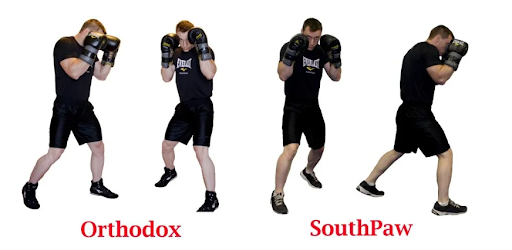
a proper fight stance sees your lead foot forward (see boxing), weight evenly distributed on your body. feet are kept light and active to facilitate quick movements when necessary. hands are up and orbiting your temples in a slightly-closed (think claw) or fully-closed fist. elbows are kept close to body and seek to protect the ribs. shoulders are forward but not tensed up.
tracking the opponent
this is a fundamental step in good combat defense, both striking and grappling. when in a combat scenario, after the initial examination of the opponent, do not waste time focusing on specific parts of your opponent’s body. this will only be a distraction and can cause you to get hurt, taken down, etc.
your eyes should be focused around the bridge of the opponent’s nose. this will allow you, out of the corner of your eyes, to spot their eye movements (for hints towards their next move), arms, shoulders, hips, and legs. any of these spots give crucial clues as to what your opponent is planning without you breaking your focus.
defending high strikes
parrying
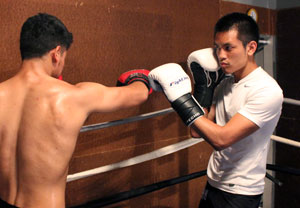
most common with straight blows, parrying can not only deflect incoming damage, it can open opportunities for you to counterstrike with your own shot. do not overextend with your hand as the blow is approaching—meet the blow where it is and smack it away from you.
straight blows
much of your defense from jabs and crosses stems from your already-present fight stance. if you have remained in your fight stance in good form (minding arm, hand, and shoulder positioning), you only need to move your already-defending arms to defend. do not extend your arms out—simply keep your chin and face covered within your fight stance, pushing back ever so slightly on the punch if possible.
hooks
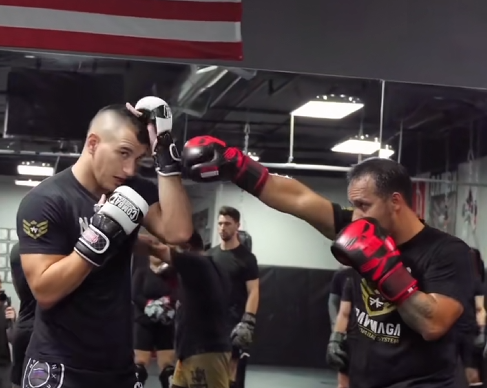
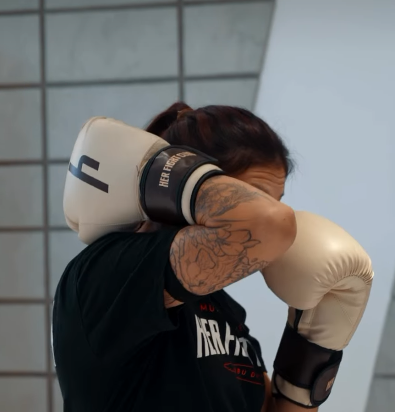
pull your defending hand back towards the back of your head, the bicep of your defending arm making contact with your cheek. if successful, you will likely not be able to see through your eye on that side. be careful with this defense, as doing it with improper form can make you hit yourself too. keep your other arm in a defensive position by your chin in case your opponent attempts to fake out the hook into another type of blow.
defending low strikes
in a guarded stance, raise the appropriate knee up as close to your elbow as possible (WITHOUT getting low or changing the rest of your stance) to absorb a kick or low blow.
your legs are not as fragile as other parts of your body (like your arms) so it is crucial to use your legs as much as possible.
leg catching
if you find an opportunity to catch a thrown kick, do not grab the leg with your hand. instead, use your full arm to anchor the leg before it fully hits your body (step a little to the side away from the kick in order to reduce the damage). swing your forearm to be underneath the leg, and squeeze tightly as if flexing your bicep (the caught ankle should be in between your bicep and forearm). you can push it away across your body and retaliate with your own kick with this setup.